RUIDOSO, N.M. (AP) — A wind-driven wildfire swept through neighborhoods in a mountain community in drought-stricken south-central New Mexico, burning at least 150 structures and forcing the evacuations of schools with 1,700 students, officials said Wednesday.
Homes were among the structures that burned on Tuesday, but officials did not have a count of how many were destroyed in the blaze that torched at least 6.4 square miles of forest, brush and grass on the east side of the community of Ruidoso, said Laura Rabon, spokesperson for the Lincoln National Forest.
No deaths or injuries were reported from the fire fanned by winds gusting between 50 mph and 90 mph, Rabon said. The cause of the fire was under investigation.
Ruidoso’s high school and middle school were evacuated but didn’t burn. Officials in the village declared a state of emergency for the community and said school classes were canceled Wednesday as the village coped with power outages due to down power lines.
The residences that burned were mostly a mix of trailers and single-family homes, and close to 4,000 people were displaced by evacuations. Village spokeswoman Kerry Gladden said authorities were out trying to survey as much damage as possible before Wednesday afternoon, when winds were expected to gust again, raising the fire threat.
“Right now, everybody is just rallying around those who had to be evacuated,” Gladden said. “We’re just trying to reach out to make sure everyone has places to stay. Plus in the middle of all this, our village is still without power. Everybody is just trying to get the resources here on the ground where they’re needed and get everyone fed.”
Ruidoso in 2012 suffered one of the most destructive wildfires in New Mexico history, when a lightning-sparked blaze destroyed more than 240 homes and burned nearly 70 square miles.
Rabon said the latest fire continued burning overnight but was less intense.
However, no precipitation was in the forecast and humidity levels remained low, Rabon said.
“Those extremely dry conditions are not in our favor,” she said.
Another wildfire in the Lincoln National Forest northwest of Ruidoso burned at least 400 acres after it was sparked Tuesday by power lines downed by high winds, Rabon said.
Elsewhere in New Mexico, wildfires were burning along the Rio Grande south of Albuquerque, in mountains northwest of the community of Las Vegas and in grasslands along the Pecos River near the town of Roswell.
Adolphe Pierre-Louis/The Albuquerque Journal via AP
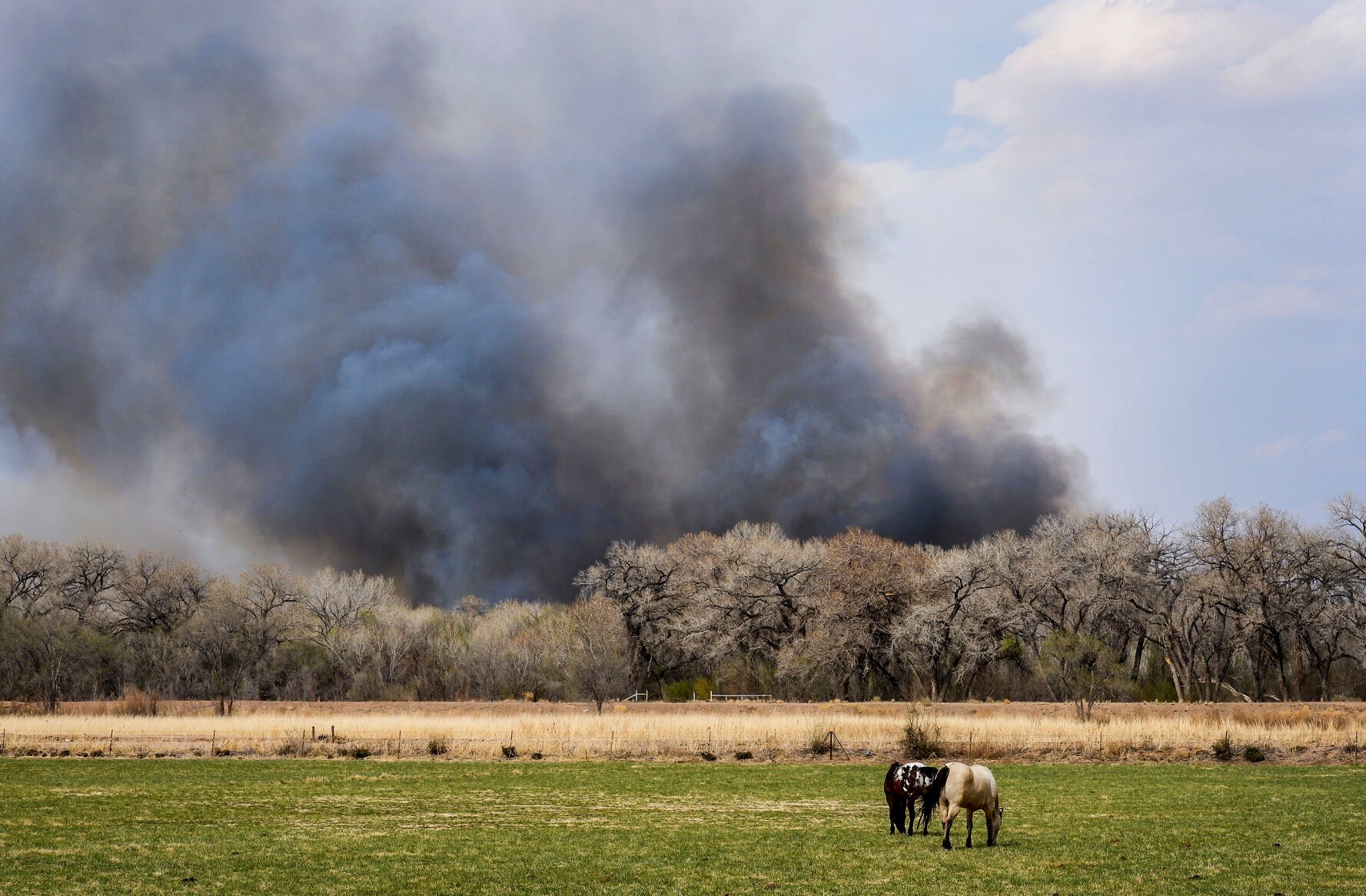
Horses graze in a field while a fire rages in Belen, N.M., on Monday.
-
How wildfires have worsened in recent years
KYLE GRILLOT/AFP via Getty Images
A series of lightning storms in mid-August 2020 hit Northern California, a region already experiencing a severe drought season, igniting what would become the August Complex fire. Over the course of almost three months, it burned through national forests, destroying 935 buildings and forcing the evacuation of thousands of people. By the time it was fully contained, its total range was over twice the size of California’s previous record and among the largest fires in U.S. history.
Less than a year later, the August Complex’s record was nearly broken when the Dixie fires broke out in Northern California, burning more than 963,000 acres and destroying more than 1,300 structures in the region.
Stacker cited data from the National Interagency Fire Center, National Oceanic and Atmospheric Administration, and the California Department of Forestry and Fire Protection to visualize how the spread of wildfires has worsened in recent years.
New breakouts of megafires (fires burning in excess of 100,000 acres) have become a seasonal repetition in the Western United States. Wildfires are innate to forest ecosystems, clearing out dead debris and paving the way for new growth, but climate change has elongated dry seasons, increased temperatures, and widened the potential for large-scale wildfires. Beyond weather-related factors, the prevalence of insects like bark beetles damage trees and make them more prone to burning. Invasive vegetation such as cheatgrass also easily burns and contributes to spread.
Trees, traditionally a storage vessel for carbon, release carbon immediately when burning and during decomposition. The EU’s Copernicus Atmosphere Monitoring Service estimated that global wildfires in 2021 released 1,760 megatonnes of carbon emissions, just over what the nation of Russia emitted in 2020. Black carbon, or soot, can also travel beyond wildfire zones, absorbing sunlight and warming the earth further.
Beyond the environmental threats, the widening reach of wildfires threatens the displacement of countless residents. The Marshall fire in January of this year destroyed more than 1,000 homes in Colorado, demonstrating the harm a wildfire can cause in a densely populated area such as the suburbs. The Camp Fire in 2018 permanently displaced an estimated 20,000 residents in California’s Butte County. Despite this, people continue moving to wildfire-prone areas, putting a growing population at risk of longer fire seasons and associated health risks.
You may also like: How climate change impacts extreme weather across America

KYLE GRILLOT/AFP via Getty Images
A series of lightning storms in mid-August 2020 hit Northern California, a region already experiencing a severe drought season, igniting what would become the August Complex fire. Over the course of almost three months, it burned through national forests, destroying 935 buildings and forcing the evacuation of thousands of people. By the time it was fully contained, its total range was over twice the size of California’s previous record and among the largest fires in U.S. history.
Less than a year later, the August Complex’s record was nearly broken when the Dixie fires broke out in Northern California, burning more than 963,000 acres and destroying more than 1,300 structures in the region.
Stacker cited data from the National Interagency Fire Center, National Oceanic and Atmospheric Administration, and the California Department of Forestry and Fire Protection to visualize how the spread of wildfires has worsened in recent years.
New breakouts of megafires (fires burning in excess of 100,000 acres) have become a seasonal repetition in the Western United States. Wildfires are innate to forest ecosystems, clearing out dead debris and paving the way for new growth, but climate change has elongated dry seasons, increased temperatures, and widened the potential for large-scale wildfires. Beyond weather-related factors, the prevalence of insects like bark beetles damage trees and make them more prone to burning. Invasive vegetation such as cheatgrass also easily burns and contributes to spread.
Trees, traditionally a storage vessel for carbon, release carbon immediately when burning and during decomposition. The EU’s Copernicus Atmosphere Monitoring Service estimated that global wildfires in 2021 released 1,760 megatonnes of carbon emissions, just over what the nation of Russia emitted in 2020. Black carbon, or soot, can also travel beyond wildfire zones, absorbing sunlight and warming the earth further.
Beyond the environmental threats, the widening reach of wildfires threatens the displacement of countless residents. The Marshall fire in January of this year destroyed more than 1,000 homes in Colorado, demonstrating the harm a wildfire can cause in a densely populated area such as the suburbs. The Camp Fire in 2018 permanently displaced an estimated 20,000 residents in California’s Butte County. Despite this, people continue moving to wildfire-prone areas, putting a growing population at risk of longer fire seasons and associated health risks.
You may also like: How climate change impacts extreme weather across America
-
How wildfires have worsened in recent years
Emilia Ruzicka / Stacker
Throughout the mid-20th century, forest management largely focused on preventing forest fires of all scales. Smokey the Bear was a national mascot for fire prevention, overseeing a multi-decade decrease in the number and average size of fires. But without regular fires, debris built up. This, combined with other environmental factors, eventually fueled costlier, large-scale blazes that have come to define the current wildfire season.
Despite having nearly 10,000 fewer fires per year on average from 2011-2021 compared to 1983-2010, the average acreage burned by those fires per year has more than doubled. From 1983-2010, the average number of acres burned per year was about 4.4 million. That number has jumped to 7.5 million acres per year for the 2011-2021 time period.
Emilia Ruzicka / Stacker
Throughout the mid-20th century, forest management largely focused on preventing forest fires of all scales. Smokey the Bear was a national mascot for fire prevention, overseeing a multi-decade decrease in the number and average size of fires. But without regular fires, debris built up. This, combined with other environmental factors, eventually fueled costlier, large-scale blazes that have come to define the current wildfire season.
Despite having nearly 10,000 fewer fires per year on average from 2011-2021 compared to 1983-2010, the average acreage burned by those fires per year has more than doubled. From 1983-2010, the average number of acres burned per year was about 4.4 million. That number has jumped to 7.5 million acres per year for the 2011-2021 time period.
-
-
How wildfires have worsened in recent years
Emma Rubin / Stacker
The total acres burned by wildfires in December 2020 was three times greater than the 10-year average for the month. The following year also experienced a damaging December, with a less extensive but still above average spread covering 336,984 acres. Wildfire season traditionally lasts May through October, but shorter winters and earlier snow melts have extended wildfire risk. 2021 set a record for days at preparedness level 5, the highest alert for wildfire risk.
The USDA Forest Service warned in 2021, “For years, agencies relied on seasonal firefighters for summer months, but now that wildfires are burning into the winter, they need to reevaluate their hiring plans.”
Emma Rubin / Stacker
The total acres burned by wildfires in December 2020 was three times greater than the 10-year average for the month. The following year also experienced a damaging December, with a less extensive but still above average spread covering 336,984 acres. Wildfire season traditionally lasts May through October, but shorter winters and earlier snow melts have extended wildfire risk. 2021 set a record for days at preparedness level 5, the highest alert for wildfire risk.
The USDA Forest Service warned in 2021, “For years, agencies relied on seasonal firefighters for summer months, but now that wildfires are burning into the winter, they need to reevaluate their hiring plans.”
-
How wildfires have worsened in recent years
Emilia Ruzicka / Stacker
With the increasing severity of wildfires every year, it follows that more resources are required to tame the blazes. In 1999, just before the turn of the century, the Forest Service and all other Department of the Interior agencies spent a combined $515.5 million on wildfire suppression. During the course of the last decade, the average cost of wildfire suppression has skyrocketed to nearly $2.1 billion annually. The Forest Service carries the brunt of this cost, contributing approximately three-quarters of the funds each year.
Though there is not currently an official tracking mechanism for the cost of wildfire damages, academics across the country have attempted to estimate the economic impact of wildfires. In 2020, a team of researchers estimated that the 2018 California wildfires caused $148.5 billion in economic damages.
Emilia Ruzicka / Stacker
With the increasing severity of wildfires every year, it follows that more resources are required to tame the blazes. In 1999, just before the turn of the century, the Forest Service and all other Department of the Interior agencies spent a combined $515.5 million on wildfire suppression. During the course of the last decade, the average cost of wildfire suppression has skyrocketed to nearly $2.1 billion annually. The Forest Service carries the brunt of this cost, contributing approximately three-quarters of the funds each year.
Though there is not currently an official tracking mechanism for the cost of wildfire damages, academics across the country have attempted to estimate the economic impact of wildfires. In 2020, a team of researchers estimated that the 2018 California wildfires caused $148.5 billion in economic damages.
-
-
How wildfires have worsened in recent years
Emma Rubin / Stacker
At the national level, 89% of wildfires were caused by humans in 2021, but human-caused wildfires contributed only to 42% of total acreage burned. In the Southern and Eastern U.S., human-caused fires still cause the most damage, but elongated dry seasons in the West have intensified the impact of lightning when it does strike.
Dry lightning is created through high-altitude thunderstorms. Extreme heat and drought can cause rain to evaporate before it reaches the ground. Lightning fires can also pose greater damage because it can take longer for them to be detected, whereas human-caused fires are often closer to towns and high-traffic areas. Winds associated with dry thunderstorms can further fan the flames as well. These factors mean that even as the West is less prone to lightning than other parts of the country, the bolts can spark more damage.
Emma Rubin / Stacker
At the national level, 89% of wildfires were caused by humans in 2021, but human-caused wildfires contributed only to 42% of total acreage burned. In the Southern and Eastern U.S., human-caused fires still cause the most damage, but elongated dry seasons in the West have intensified the impact of lightning when it does strike.
Dry lightning is created through high-altitude thunderstorms. Extreme heat and drought can cause rain to evaporate before it reaches the ground. Lightning fires can also pose greater damage because it can take longer for them to be detected, whereas human-caused fires are often closer to towns and high-traffic areas. Winds associated with dry thunderstorms can further fan the flames as well. These factors mean that even as the West is less prone to lightning than other parts of the country, the bolts can spark more damage.
-
How wildfires have worsened in recent years
Emma Rubin / Stacker
While lightning has sparked some of the most devastating fires in California including the August, SCU, and LNU complex fires, powerlines have also fueled far-reaching damage. Contact with overgrown trees, downed lines, and frayed wires can spark flames. Pacific Gas & Electric was held responsible for the 2018 Camp Fire and 2019 Kincade Fire and has instituted rolling blackouts on high-risk wildfire days.
Even as the origin of fires varies, each is exacerbated by existing environmental factors. A 2018 survey from the USDA Forest Service identified nearly 150 million trees that died between 2010-2018 in California. Two years later, 2020’s record season burned nearly 4.4 million acres and the five largest megafires happened concurrently in August and September. The season demonstrated how the buildup of vulnerable trees can ignite unprecedented spread.
A 2021 aerial survey by the USDA Forest Service offered some hope. Annual tree mortality has declined over the past five years, with an estimated 9.5 million dead trees in the state spanning more than 1 million acres, although tree mortality remains at a much higher rate than California’s pre-drought levels in the early-2000s.
You may also like: Climate change’s impact on the wine industry
Emma Rubin / Stacker
While lightning has sparked some of the most devastating fires in California including the August, SCU, and LNU complex fires, powerlines have also fueled far-reaching damage. Contact with overgrown trees, downed lines, and frayed wires can spark flames. Pacific Gas & Electric was held responsible for the 2018 Camp Fire and 2019 Kincade Fire and has instituted rolling blackouts on high-risk wildfire days.
Even as the origin of fires varies, each is exacerbated by existing environmental factors. A 2018 survey from the USDA Forest Service identified nearly 150 million trees that died between 2010-2018 in California. Two years later, 2020’s record season burned nearly 4.4 million acres and the five largest megafires happened concurrently in August and September. The season demonstrated how the buildup of vulnerable trees can ignite unprecedented spread.
A 2021 aerial survey by the USDA Forest Service offered some hope. Annual tree mortality has declined over the past five years, with an estimated 9.5 million dead trees in the state spanning more than 1 million acres, although tree mortality remains at a much higher rate than California’s pre-drought levels in the early-2000s.
You may also like: Climate change’s impact on the wine industry

